WBA is a partner in the EU funded GoNaturePositive! project which supported this independent and scientifically rigorous benchmarking process as part of joint efforts to build an evidence base for transformative change towards a nature-positive economy.
EU companies dominate top performers
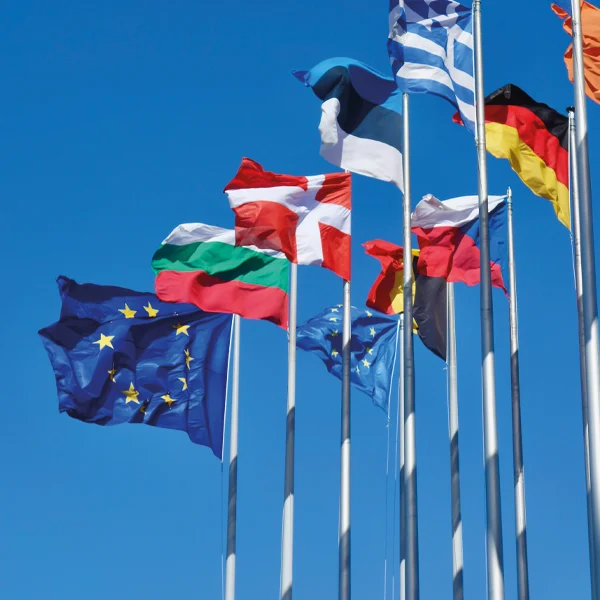
The results of this Nature Benchmark show that EU-headquartered companies account for 11 of the top 20 best performing companies, rising to 18 out of 20 when companies from the UK, Switzerland and Norway are included. Arla Foods from Denmark is the only private company making it into the top 20, with publicly quoted companies making up the vast majority of top performers.
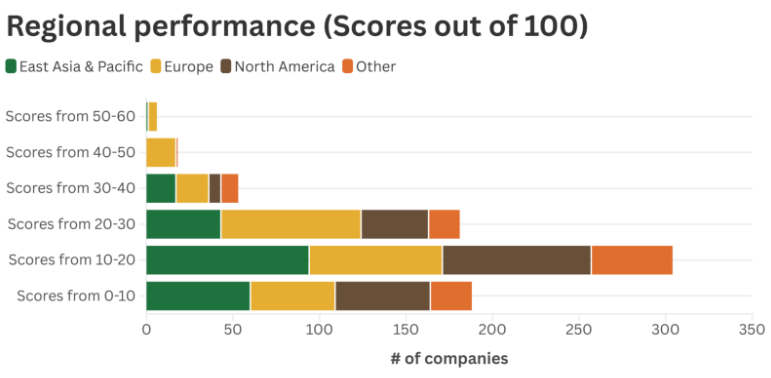
WBA reports that across all 750 companies benchmarked, European companies are the global leaders on nature performance, followed by strong performances from South African, Thai, Australian, Japaneseand Taiwanese companies. Companies in China, Vietnam and India lag behind, along with those in North and South America (see figures below).

“Today’s benchmark results reveal a wide range in company performance – showing that companies can already make a positive impact. While the EU remains a global leader in driving businesses to adopt more sustainable practices, strong performance in other markets – especially Australia, Japan, South Africa, Taiwan and Thailand – shows that businesses globally are waking up to the risks and opportunities that the global biodiversity crisis poses.” — Bosco Lliso, Research Lead, WBA.
Performance bar
However, the results also show that the performance bar is low with an average score of 17/100 across all companies, with even the best performing companies scoring under 60/100. Particularly poor performance was noted against indicators which are considered important for transformation towards a nature-positive economy with only 2% of companies disclosing a nature transition plan aligned with the Global Biodiversity Framework or nature-positive principles. These early movers show that some large businesses are starting to embed the concept of nature-positive in their business plans and strategies.
Financial risks mount as companies fail to plan
These low levels of planning to assess and reduce nature impacts are concerning given that approximately 75% of all bank loans in the euro area (to more than three million companies) are granted to companies with high dependency on at least one ecosystem service (ECB, 2023). Meanwhile, biodiversity loss and ecosystem collapse ranked second only to extreme weather events in the World Economic Forum’s 2025 Global Risks Report – a list of over 33 risks expected to deteriorate significantly over a 10-year horizon (WEF, 2025) – showing that the perception of such risks has shifted from being a long-term concern to a more urgent reality.“In GoNaturePositive!, we are seeing that while business awareness of nature-related impacts and dependencies is generally low, the financial community and insurance sector are increasingly aware of these risks and are calling for urgent action. We are activating a whole-of-society approach to address these risks – working with businesses, investors, policy makers and communities to accelerate action towards a nature-positive economy.” — Siobhan McQuaid, Coordinator GoNaturePositive!, TCD.
WBA results also underscore the importance of a strong regulatory environment on company performance – with hundreds of companies’ 2025 disclosures already referencing the Corporate Sustainability Reporting Directive (CSRD) and European Sustainability Reporting Standards (ESRS). Outside of Europe, companies in Thailand and South Africa are emerging as global leaders in large part due to the strong regulatory environment in place in these countries.
The recent Omnibus Simplification Package in the EU has been criticized for substantially weakening corporate sustainability regulations in Europe with many companies being removed from reporting requirements. The impacts of such simplification measures on European company performance will only be seen in the next WBA benchmark, however, regulatory delays and uncertainty threaten continued EU leadership on nature performance.
Grounds for optimism from climate progress
Some grounds for optimism can be seen from comparing company performance on nature with company performance on other sustainability indicators like greenhouse gas emissions. 63% of companies benchmarked have targets in place for greenhouse gas (GHG) emissions. The marked improvement in GHG performance is underpinned by the increased maturity of regulatory and reporting frameworks such as TCFD and SBTi.
Similar frameworks have emerged on nature, such as TNFD and SBTN, leading to hopes that company learning from GHG reporting can help to accelerateimproved performance on nature. WBA results show that currently only 3% of companies explained the alignment or tradeoffs between its nature and climate transition plans. The complexity of nature reporting however must be acknowledged along with the gaps in guidance and support for many smaller businesses falling outside the scope of EU regulations.
Turning insights into action
EU funded initiatives such as GoNaturePositive! are leveraging these new findings from WBA to respond to market gaps. As part of their whole-of-society approach to transforming the economy to nature-positive, GoNaturePositive! are working with business, finance, government and communities in five EU countries and Colombia to pilot nature-positive transformation in the agro-food, forestry, building, tourism and blue economy industry sectors.
“With biodiversity plummeting, it’s more important than ever that solutions are scaled up fast. The concrete examples of leading practices already being implemented by large businesses should be replicated by others, while the innovative work of the GoNaturePositive! pilots show how both large companies and nature-based enterprises can deliver environmental restoration, economic viability, and social value at the same time. Everyone has a part to play in the transition to a Nature Positive economy.” — Jenni Black, Head of Corporate Engagement, WBA.
The WBA Nature Benchmark 2026 assessed 750 companies across multiple sectors including agro-food, forestry, building, tourism and blue economy. Full results and methodology are available at https://www.worldbenchmarkingalliance.org/
About the World Benchmarking Alliance (WBA)
Founded in 2018, the World Benchmarking Alliance is a non-profit organisation holding 2,000 of the world’s most influential companies accountable for how they impact people and the planet. It does this by publishing free and publicly available benchmarks on their performance and showing what good corporate practice looks like. Collectively, these 2000 companies generated over USD 53 trillion in revenue, equivalent to approximately 48% of global GDP. The benchmarks and their methodologies provide companies with a clear roadmap of what commitments and changes they must make in order to put our planet, society and economy on a more sustainable and resilient path. The WBA benchmarking process follows a 2-year development and assessment process. In the first year, expert panels guide the development of benchmark indicators. In the second year, initial data collection and preliminary assessments are completed using internal and external analysts, and draft assessments are sent to companies providing an opportunity for feedback. Following this process, the final results are published at the end of this 2-year cycle.
About GoNaturePositive!
GoNaturePositive! is a four-year EU Horizon Europe initiative involving 20 partners spanning 14 different countries, focused on accelerating the transition to a Nature-Positive Economy. A Nature-Positive Economy is one in which the net result of all economic activities combined leads to an absolute increase in nature, to the point of full recovery, and prosperity for all of society. GoNaturePositive! develops a shared conceptual framework for the nature-positive economy and supports its implementation through policy analysis, market insights and real-world pilot projects across key sectors, including agri-food systems, forestry, tourism, the built environment and the blue economy. The project brings together expertise from research, business, finance, public authorities and civil society to demonstrate how nature-positive practices can be applied in practice and scaled over time. Stakeholders are invited to join the GoNaturePositive! community to engage with evidence, tools and pilot-based learning that support policy development, investment decisions and systemic change, contributing to the delivery of EU biodiversity, climate and sustainability objectives. Learn more here: https://www.gonaturepositive.eu/
Reference:
European Commission: Directorate-General for Research and Innovation, McQuaid, S., Zandersen, M., Brophy, M., Rizzi, D. et al., Policy imperatives for a competitive and resilient nature-positive economy, Publications Office of the European Union, 2025, https://data.europa.eu/doi/10.2777/8109329